Saturday, August 3, 2013

Harpers Bizarre

I've stumbled upon this fantastic website for reading about music. It's http://www.allmusic.com/. While half-watching a ballgame the other night, I navigated the site, typing in many of the performers that I've followed for years. It was deeply satisfying to see their work put into context, and most times I agreed with the critical opinion offered. (Lots of mental back-patting going on too, as I saw that many of my favorites are well regarded.)

There were moments when the reviewer stated opinions that clarified thoughts that I'd had. I love Loudon Wainwright III, so I'm unlikely to speak out if I sense that a song he's doing isn't working. But the All-Music critic did in his review of Loudon's latest, Older Than My Old Man Now. Of several of Loudon's comedic efforts, reviewer Thom Jerek writes "Not everything works here, however. "I Remember Sex" with Barry Humphries (Dame Edna Everage), and "My Meds" are just plain bad; "Double Lifetime" with Ramblin' Jack Elliot reveals Wainwright's humor stretched to the metaphorical breaking point." I felt it, but being such a fan, I couldn't say it. But now it's out there, and I appreciate the straightening of my vision regarding Loudo.

But I must defend this group from the late 1960s, Harpers Bizarre, from the slings and arrows of critics on the site.

This group's work has been described as "soft psychedelic or soft AM pop" (Amazon) and "Broadway/Sunshine pop" (Wikipedia). I find their music incredibly distinctive and a taste, once acquired, that you won't be able to lose because it's so infectious.

http://www.musicpophits.com/images/MusoPage/MainHarpersBizarre.jpg
How to be twee: wear a collar and tie in 1967 when you're in your twenties!


Sure, you may need time for acclimation, but it's perfect background music as you go about your chores. Their repertoire is impeccable: for example, they perform songs by Cole Porter ("Anything Goes," "Two Little Babes in the Woods"), Randy Newman (too many to mention, but highlights include "The Biggest Night of Her Life" and "Snow"), and the Gershwins ("I'll Build a Stairway to Paradise").

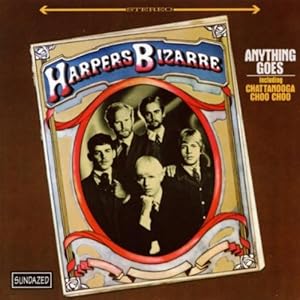
The title track of their initial effort, Feelin' Groovy, yielded a Top Ten hit and it receives All-Music's highest rating in their discography. But then the slams follow. Of their next release Anything Goes (and this one was my first exposure to them) the All-Music critic sniffs that it's "rock for the kiddies" or perhaps "rock for the old folks" and "way too twee" to be meaningful. To make matters worse, the critic refers to Randy Newman's orchestrations as "LA pop-rock schmaltz."
http://ecx.images-amazon.com/images/I/51FUdON5C3L._SY300_.jpg
The second album: let the savaging by All-Music begin!
I understand that this opinion represents the case against the group, and undoubtedly many people will agree with it. I guess I've spent my life being slightly off-center in my musical tastes, so allow me to fire back with a defense.

First of all, the talent associated with this group is stunning. You have producer Lenny Waronker at the helm. Described as Newman's "unofficial song-plugger" at the time, Waronker would later rise from producing to becoming the head of A&R (Artists & Repetoire) at Reprise Records in 1971. He would subsequently become head of Warner Brothers and executive at Dreamworks. Check out this fascinating interview with him. Lots of wisdom there!

Ted Templeman, the lead vocalist for Harpers Bizarre, was soon to produce all of the Doobie Brothers' work. All-Music describes him as having a "strong, clear production aesthetic."

Here are some other musicians whose names dot the releases of Harpers Bizarre: Leon Russell, Lee Herschberg, and, of course, Randy Newman. After reading their biographies you have to marvel at the workshop that was Harpers Bizarre.

But mostly it's the songs. In his interview, Lenny Waronker repeatedly says that as an artist you must have good material. Boy, could he and Harpers Bizarre choose it! Their list is so diverse: you've got Otis Redding songs ("Hard to Handle," "Knock on Wood") stirred in with composers from the prerock era (Frank Loesser, Burton Lane, even Rodgers and Hammerstein!) Plus I love the songs that the band members themselves write.

Now let's return to the disdain displayed of most of their work on All-Music. Their work is "mildly eccentric," writes one reviewer of the The Secret Life of Harpers Bizarre, as it "skirts adult contemporary Muzak almost as it does anything that could be considered rock music, and is rather a dark day in the annals of sunshine pop." The followup, 1969's Harpers Bizarre, is described as a "fussy sunshine pop production" and "a soft rock marshmallow that was easier to swallow than their gooiest previous concoctions."

Perhaps I should stop here or my high praise of the group will completely lose its power! All I can say is that although I love the language and I fully understand the dissension, I can't agree with it. I love the true eccentrics, and that's what these guys were when you consider the historical moment musically. The "counter counterculture" is how Van Dyke Parks recently put it. Indeed.

Give Harper's Bizarre a listen. I hope you'll be delighted. 

Saturday, March 9, 2013

The Original One Man Guy


Loudon Wainwright III has been a good friend of mine through the years. You see, I speak as if I know him because he's been telling me about his life with every record. At first, he was an amazingly distinctive voice. I was introduced to him on his second release, Album II. How high-pitched his voice was, and how strange his storytelling. He sang about persuading a woman to come up to his hotel room, about contemplating suicide, and about himself and a cat. He was idiosyncratic like my hero Randy Newman- confessional and self-deprecating, but in a very neurotic way.

Loudon kept up the pace and established a market presence, but like many songwriters, he was upended by disco and punk. Seemingly shuttled into irrelevance after recording two albums for Arista, Loudon wasn't heard from for about five years. But then he re-emerged on the Rounder Records label, and spent the 1980s digging into the central themes of his work: exploring his need for solitude, his familial relationships, and his manhood.


Loudon uses simple language in his songs. He takes worn phrases and reverses them, creating new meaning by connecting them to his own conflicts. Over the years his voice has deepened, and his singing has become masterful. Never is this more evident than exploring the treasures in a boxed retrospective of his work, 40 Odd Years.

I strongly recommend that you sit and enjoy the DVD of performances and interviews that are included in this collection. I found myself mesmerized yet again by him. What an amazing body of work! I found myself remembering when I first heard many of the songs, and they stand the test of time nicely. He is an engaging presence - a funny guy who doesn't hesitate to show his sadness.

I've gone to hear Loudon many times, and I still follow him closely. This release gave me a chance to spend some "quality time" with him and it was extremely pleasurable. If he's a stranger to you, or if you've not listened much over the years, give it a listen. You won't be disappointed!


Tuesday, February 12, 2013

You Can't Beat Bennett


If you could time travel, what time period would you choose? After enjoying Tony Bennett's new book, Life Is a Gift: The Zen of Bennett, I can tell you without reservation that I'd have loved to have been shoulder-to-shoulder with Tony as he visited jazz clubs along 52nd Street in New York in the 1950s. Billie, Louie, Ella - you name the vocal great, and they were fully alive and practicing!

This book reminds me of two other recent memoirs I've enjoyed: Neil Young's Waging Heavy Peace and Willie Nelson's The Facts of Life: and Other Dirty Jokes. The authorial voice is completely authentic. In Young's book, I was struck by how much he was in the present: at various turns he talked about trying to sell music executives on a new sound recording system. You can feel him jump off the page. Same thing with Nelson. For someone who has crafted such wonderful and wise lyrics, he's totally a "down home" person. He's got many groaners in his dirty joke bag, but his love for them gives you a true sense of his personality. 

Tony Bennett's written voice is the same way. You will not hear anything close to negative in his remarks. His relentless optimism might drive you batty until you realize that the fellow is just being himself: protecting the "brand" that he's worked so hard to establish. It's good business and in no small measure it's also what has kept him on this earth for 86 years. 

Here's what is clear from this memoir: Tony is a very proud man (there's not an album in his catalog that he's ashamed of, he says, on the occasion of the publication of all of them in a $400 boxed set). He's justifiably proud of how hard he's worked and persisted. He cares about quality - always has, from the start of his career when he had to wrestle with Mitch Miller (the deal: one jazz album for each gimmicky pop album suggested) to his refusal to kowtow to Clive Davis at Columbia in the late 1960s and record more contemporary material. 

There's a characteristic Tony Bennett mode of delivery that Alec Baldwin caught beautifully on a Saturday Night Live skit (with Tony in on the joke). But don't think his presentation is ever canned. He is a true jazz singer - always sensitive to the moment and deeply in touch with his audience. He varies his pitch and his tone. He is always true to the lyric. Like all great singers, he tells the story.

Working 3 shows a night at the Copacabana and 7 an evening at the Paramount when he was starting out, one truly appreciates how this singer gained his chops. He cranked out 2 to 3 albums a year into the late 1960s. He has rarely gotten off the performing wheel, save for a downturn in the late 1970s (one for which he'd be rescued by his son who became his business manager).

I love the man. I'll never forget him signing an album for me one morning when I attended a public signing at a local department store. I'll always cherish when my family took my father to see him at the Arie Crown Theater in northern Chicagoland. 

Give this book a chance. You'll embrace this great American and put his music on. What a relaxing and satisfying place to be!

Tuesday, August 14, 2012

A Terrific Musical Memoir


"I don't like country music, but I don't mean to denigrate those 
who do. And for the people who like country music, denigrate means 
'put down.'" 
  -- Bob Newhart


Growing up in Pittsburgh, I wasn't much of a country music fan. What I knew of it came from two sources: my father's Patsy Cline records, and the FM stations on our radio that played true country (hillbilly) music from West Virginia. I couldn't bear to listen to the latter for too long.

I became much more familiar with country when I became a Willie Nelson fan. By that time I had a sense of what a musical giant Hank Williams was in this genre. But now, after reading Rheta Grimsley Johnson's memoir Hank Hung the Moon and Warmed Our Cold, Cold Hearts, I have a deeper understanding of what he means to Southerners.


This is a wonderful piece of writing, and a labor of love. Johnson, cleaning the attic after the death of a her husband, comes across the interviews he'd done in preparation for a book about Hank Williams that never came to fruition. The fact that this work was done with a former wife is no impediment to Johnson: she decides to draw upon these "Hank enthusiast's" research in her own book on the subject.

I love how at the start she quotes Elvis Costello on writing about music. He once said that "Writing about music is like dancing about architecture. It's a really stupid thing to want to do."

Believe me, I can relate to this statement. How often I've read concert or CD reviews and felt the futility of the writer trying to describe a sound or a feeling created.  Johnson will go on however:

"But all of us who string words together in feeble attempts to tell a story half as well as Hank, all of us think we have something to add to the legend, another way to interpret genius. Mostly we want an excuse to get closer to the music and the man. For we need Hank for something more elemental than entertainment, sometimes in an urgent way. We need him to continue to function in this life, to make sense of things, to help wrestle down demons. We need him the way gandy dancers need their rhythmic chants to get through a ten-mile stretch of railroad repair. The way a beautician needs bobby pins. Hank was more than our troubadour. He was, in a way, our savior."

So we travel with Johnson to visit Hank Williams's daughter Jett. (She only learned she was his daughter practically three decades after he died!) We meet Hugh Harris, an accomplished Hank impersonator. Johnson also interviews Hank Braxton Schuffert, who knew Hank and, subscribing to a more temperate lifestyle, is around to tell the tale more than half a century later.

But the book is a memoir, and Johnson skillfully weaves in her life story along with the interviews. You get to appreciate what life was like growing up in rural west Georgia, and how Hank speaks for true country people.

Hank Hung the Moon has me eager to revisit Williams's music. I'll bet that it will have the same effect upon you. I'd like to end with a memorable passage from the book in which Johnson, reflecting upon the music lessons she took as a girl, draws a connection between music and writing.

"I have read and subscribe to the theory than any writer worth her salt needs to take a few music lessons and some sailing lessons before attempting to write. A writer, goes the argument, needs to know the poetry and the lilting language of both pursuits, those phrases that sound like what they are: crescendo and listing, for examples. You call on the language of music and the sea at every turn to make prose pretty. They become the memorable phrases, the ones with salt and sea spray and - shall I say it? - rhythm."

Isn't that terrific writing? Check out this book! Here's the author on You Tube.

Monday, July 23, 2012

Carly Simon


After reading the recent unauthorized biography on Carly Simon, I've been thinking a lot about her. I find her such an interesting artist, and a fascinating person.

Like most people, she's a tangle of contradictions. When you're a public figure, your foibles are thrown in high relief. So you have Carly Simon the exhibitionist who hardly ever posed for her albums without wearing something provocative. She's a beautiful woman, so why not? Square this with the fact that she has suffered from severe stage fright throughout her career, often to her own detriment.

You have Carly the singer-songwriter. She's the model for the confessional mode of songwriting: her life is in her song, almost as much as Loudon Wainwright's life is in his work. So she writes about broken marriages, past relationships, and her own fears. Yet she is an intensely private person. (Well, come to think of it, so is Paul Simon - no relationship, beyond the NYC connection!)

Reading the book turned me back to listening to her music. I've been enjoying her 1990 release Have You Seen Me Lately? My favorite from this one is "Life Is Eternal".

Life is eternal
Love is immortal
Death is only a horizon
Life is eternal
As we move into the light and horizon
With nothing save the limit of our sight

What a great lyric! Her voice is so distinctive: no lyric sheet is necessary because you hear the words the first time that she sings them.

I have always enjoyed her music because it hits my sweet spot. I appreciate music that is classified as "pop". I love songs that are constructed around hooks. Songs that make an unabashed effort to crawl into your brain and stay there. This is what Carly is adept at doing. It explains why she's in the Songwriters Hall of Fame along with some many of my favorites: Don McLean, Carole King, Peggy Lee, Randy Newman, Jimmy Webb, et al.

When you read about Carly you quickly appreciate what a neurotic person she is. I mean, she has been holding a torch for James Taylor for so long, it seems like such a public embarrassment. But then, your heart goes out to her. She is incredibly true and faithful. Who hasn't been guilty of not moving on? Who isn't guilty?

I wound up admiring her, and hoping that in the next year or two, when she's published her autobiography with a new album (I hope), she will sit triumphant once more. She has suffered tremendously over the past decade or so: breast cancer in the late 1990s, an ill-fated move to Beacon Hill a few years later, and - worst of all - the loss of millions of dollars to a Wall Street shyster. Then  her last album of original material (2008's That Kind of Love) that HearMusic failed to promote properly. (She lost her lawsuit over that debacle.)

After watching a Lifetime show about her in 1995 (back when she was promoting her wonderful Letters Never Sent), I've decided that Carly is someone whose spirit I'd like to celebrate. She is open-hearted and warm. She is authentic in a way that so many artists aren't.

I'll be adding to my vinyl the next time I head to the record shop, filling in the gaps in my Carly Simon collection. I am a fan. I'll never forget when she first hit in the early 1970s. And I agree with her friend Jonathan Schwartz (who's featured in the Lifetime special): her track record over the decades has been superlative. She's one of a kind.

Thursday, July 19, 2012

Cuttin' Capers by Doris Day


I'd like to devote this post to one song that's been rattling around my head lately: "Cuttin' Capers" by Doris Day. It's the title track from a 1959 album by her, and I think it's worthy of study in terms of what made Doris Day such a great singer.

First of all, to cut a caper means to "leap or frisk about" or to frolic. (I'm sure most people could figure this out by looking at the image on the album's cover and thinking about the lyrics, but I like to confirm.)

Now this notion of cutting capers seems peculiar to Doris. A decade earlier she recorded "Canadian Capers (Cuttin' Capers)", a nifty number in which she name-checks different band leaders as she skates through the lyrics, with a vocal group called The Sportsmen backing her up. A very playful number that encapsulates the optimism that is so central to her persona.

In 1959 Doris Day was at the height of her fame as a film actress. Her album sales were flagging, however. Her last best-seller was 1956's Day by Day. Apparently she and her managers had miscalculated on the follow-up Day by Night: according to the all music site the "chaste approach (on this album) may have been out of step with for the album market of the late '50s." So Doris decided to steer clear of the dreamy ballads and go up-tempo with Cuttin'Capers.

Apparently this album didn't hit the mark commercially- perhaps a continuing signal that Doris Day's brand of wholesomeness was out of step with the zeitgeist - but I find it tremendously appealing and filled with confident and creative singing.

Before I deconstruct the performance, let me give you some background on the song "Cuttin' Capers". The lyrics were composed by Joe Lubin, who had a year earlier written "Teacher's Pet" for the Doris Day/Clark Gable movie film of the same name. Lubin also worked with Little Richard on "Tutti Frutti". The music was by a man named Adam Ross (also known as Irving Roth). He had just written "That Jane from Maine" for a movie by the same name starring Doris, Jack Lemon, and Ernie Kovacs .

So we're not talking Rodgers & Hart here. These two men were basically given the charge: "We need a theme song for this album. Make it light and uptempo. Be sure it says 'You are in for some fun!'"

I think they succeeded brilliantly. Before we head to the recording, though, let's consider the conductor, Frank De Vol. His style is unmistakable if you have recordings with classic pop singers from the 1950s. De Vol's signature was to throw in an instrument that pops out from the strings and adds a touch of whimsy to the mood of the song. This style definitely feels dated and gimmicky- much more than Billy May's, another busy uptempo conductor from the time. (His horns were grounded in Dixieland.)

So on November 29, 1958 Doris Day records "Cuttin' Capers" with De Vol, one of four numbers she put in the can with him that day. It will be the track that establishes the theme, and she starts robustly.
(Click here to listen to the song as you follow my discussion.)

Hey, look at me! (high horn trill)
Can't you see? (lower trill)
I'm in love, I'm in love, I'm in love! (Declarations are run together)

Hey! 
(This is shouted out, separated from the next phrase; a variation of what just preceded it and a clever way of vocally saying "Wake up! Listen! I'm daft!")
Look at me!
I'm cuttin' capers
I'm on a spree, see (I suspect she added the "see". She slides into it like a horn. Sweet!)
I'm cuttin' capers

I'll do that town
the way that a clown does
gonna laugh, gonna sing, gonna have a wonderful fling (slight pause after each phrase)

So here I go
I'm cuttin' capers
On with that show, oh
I'm cuttin' capers

I felt this way 
the moment you kissed me
I'm in love
 (repeated 5 times!--slows down slightly with last one, making a lilting and playful sound for the initial consonant in "love")


Doris then returns to the top. When she arrives at the "I'm in love" again, it's time to put a bow on it and bring the proceedings to a snappy ending. Here's how she does it.

I'm in love
I'm in love
I'm in love
I'm in love (These are delivered rapidly. Then she vamps.)
I'm in love (Emphasis on first word.)
So in love
(Pause. De Vol comes in with a filigree.)
I'm in love! 

It's an infectious 2 minutes and 41 minutes, well-plotted by the singer and the conductor. Sometimes I just listen and surrender to the song's happiness. Other times I get analytical and listen for patterns and repetitions, or think about how much of it was improvised that day in the studio and how much was planned in advance.

Whatever the case may be, it just illustrates why Doris Day is such a classic stylist. Recently Terry Gross scored an interview with Doris on the occasion of her 88th birthday. How wonderful to hear her voice again! Terry Gross opens by complimenting her singing, and her response is delightful. Check it out - you'll learn a lot about her!

Monday, July 16, 2012

Willie Nelson's Sharing of the Wealth


It's strange, but the introduction to the Wikipedia entry for Willie Nelson doesn't mention his enormously popular 1978 album Stardust. This record was my introduction to his world. It catapulted Willie to a completely new level. Instead of simply being the guy who wrote Patsy Cline's "Crazy" or a member of the Outlaw Country gang (of which I was completely unaware), Nelson became not only a master songwriter, but a singer. Why, let's revise that: the guy was a crooner in his own way!

I started learning the classic country songs thanks to Willie's subsequent releases,  just as listening to Pete Seeger taught me the traditional folk songs. There are so many things that I love about Willie, but the best might be what he did after he hit the pop jackpot. He turned around and recorded many duet albums with other great country songwriters. The albums showcased his partner's hits. Before long, I got to know the names Merle Haggard, Faron Young, Webb Pierce, Lefty Frizell, and Ray Price.

I've been listening lately to San Antonio Rose, a 1980 release with Willie and Ray Price. Impossible for me to tire of this collection. Favorite cuts include Willie's classic "Funny How Time Slips Away" with its stop and start shuffling rhythm and "Night Life", a song Willie co-wrote. Why does this stanza from that song always creep into my mind?

Many people just like me
Dreamin' of old used-to-be's
And the night life ain't no good life
But it's my life

It's the song's attitude that sticks - the mixture of regret and defensiveness. I also love the guitar licks that surround the bridge.

Listen to the blues they're playin'
Listen to what the blues are sayin'

What a fabulous song! Ray Price shows his vocal chops with Floyd Tillman's "This Cold War with You" and "Crazy Arms" (the latter an enormous 1956 hit for him). Price is credited with introducing something called the 4/4 shuffle. I read it was inspired by Bob Wills, whose work is also featured here in the title track and the lovely "Faded Love" that brings the proceedings to a close.

Willie Nelson chose to honor his friends when he inherited a mass audience, and I'm so grateful that he did because I have learned so many great songs. He is a singer and songwriter and artist who has moved me deeply for years. Give this duet album a listen. I know you'll get the bug and search out other collaborations from this period. It's a real treasure trove!

Click here to enjoy 82 year-old Ray Price performing in 2009. Man, everything is completely intact. What a singer!